
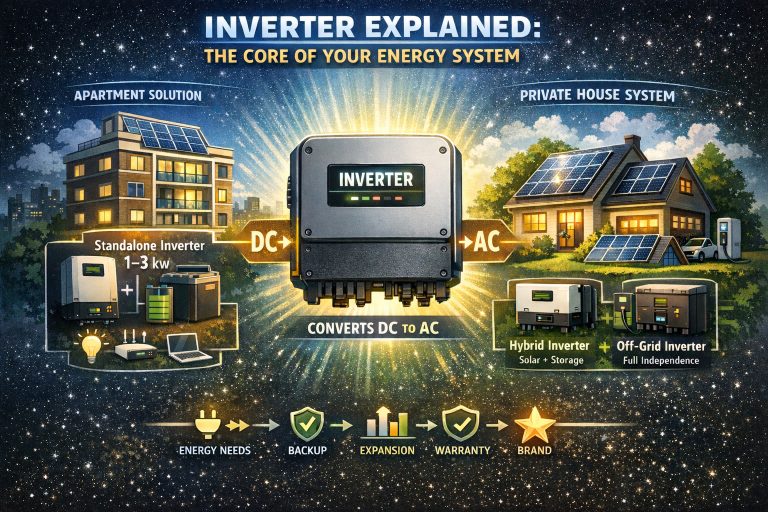

An inverter is not just another component in a solar setup — it’s the control center that makes renewable energy usable.
Solar panels and batteries generate direct current (DC).
Your home appliances operate on alternating current (AC).
Without an inverter, solar energy cannot power your home.
At Skynix, we design energy systems where the inverter is selected strategically — because the right inverter defines performance, stability, and future scalability.
Choosing an Inverter: Apartment vs Private House
Energy systems should be tailored to real consumption, property type, and long-term goals.
🏢 Apartment Solutions. Backup Power for Outages
If your goal is energy security during blackouts:
- Standalone inverter with batteries
- Recommended capacity: 1–3 kW
- Covers lighting, router, laptops, charging, and small appliances
This solution is:
- Compact
- Cost-effective
- Easy to install
A smart choice for urban environments where backup power is the priority.
Solar Panels on a Roof or Balcony
If you plan to integrate solar panels:
- Choose a grid-tied (on-grid) or hybrid inverter
- Power rating depends on panel quantity and energy usage
- Supports net metering (where available)
This setup allows you to:
- Offset electricity costs
- Use solar energy during daylight
- Add storage capacity (with hybrid systems)
🏡 Private House Systems
Private homes require more flexibility and higher capacity.
Hybrid Inverters — The Most Popular Choice:
- Store excess solar energy in batteries
- Maintain backup during outages
- Optimize grid usage
- Scale the system over time
Off-Grid Systems
Ideal for properties located far from centralized grids:
- Fully автономні рішення
- Complete energy independence
- Requires battery storage and proper system sizing
Power Recommendations
Typical inverter capacity for a house: 3–10+ kW
Why higher capacity?
Because homes often power:
- Refrigerators and freezers
- Pumps and heating systems
- High-startup-load appliances
- EV chargers
We recommend selecting an inverter with 10–20% reserve capacity to support future expansion.
Inverter Types — Strategic Overview
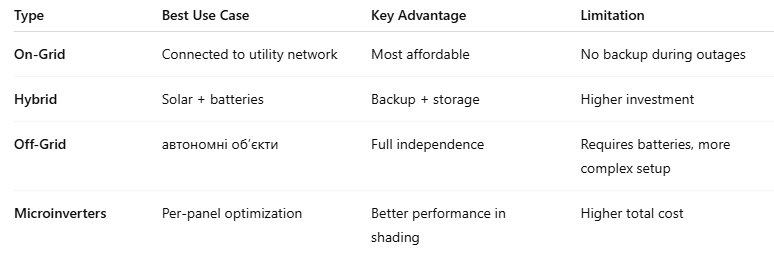
The right architecture depends on consumption profile and long-term energy strategy.
Investment Overview (Estimated 2025)
⚡Budget Segment — Small Systems
$500–1,500
- Up to ~3 kW
- Apartments and small setups
- Basic grid-tied or standalone units
⚡Mid-Range — Residential Hybrid Systems
$1,500–3,000
- 3–6 kW
- Balanced performance and reliability
- Backup-ready systems
⚡Premium / High-Capacity Solutions
$3,000+
- 6–12+ kW and above
- Three-phase systems
- Large homes with storage integration
A professional selection process includes:
- Calculating real consumption load
- Defining backup requirements
- Planning future expansion
- Evaluating warranty and service coverage
- Selecting a reliable brand
An inverter is a long-term infrastructure decision — not just equipment.
For apartments, compact grid-tied or standalone inverters typically provide sufficient capacity.
For private homes, hybrid or higher-capacity systems ensure reliability, flexibility, and future scalability.
Pricing ranges from $500 to several thousand dollars, depending on configuration and power output.
At Skynix, we don’t just sell equipment — we engineer energy systems designed for stability, efficiency, and long-term value.
👉 Visit the website and start your journey toward energy independence: https://skynix-solar.com.ua/