

For years, “learning to code” was the golden ticket into tech.
Pick a language. Learn data structures. Build projects. Get hired.
That formula worked.
But in 2026 — it’s outdated.
We’ve entered a new phase where code is cheap, but thinking is expensive.
AI can now:
- generate full features
- debug complex logic
- scaffold entire systems
So the bottleneck has shifted.
👉 The question is no longer “Can you code?”
👉 The question is “Can you think?”
1.Problem Solving > Coding
Most developers still confuse these two:
- Coding → writing syntax
- Problem solving → designing the right solution
AI already handles syntax better than most juniors.
But it still struggles with:
- unclear requirements
- real-world constraints
- trade-offs
The Real Difference
Weak approach:
“How do I build chat with WebSockets?”
Strong approach:
- Do we need real-time or near real-time?
- What about offline users?
- How do we guarantee delivery?
- What scale are we targeting?
👉 One writes code
👉 The other builds systems
Bottom line
In 2026, code is generated.
Clarity of thinking is not.
2.System Design Thinking = Real Leverage
AI can generate:
- endpoints
- UI components
- CRUD logic
But it cannot reliably design systems at scale.
That’s where seniority begins.
The Shift
Junior thinking:
“How do I build an API?”
Engineer thinking:
- REST or GraphQL?
- Monolith or microservices?
- Where does caching live?
- How do we scale?
Why it matters
Bad architecture leads to:
- slow systems
- high costs
- constant failures
Good architecture creates:
- performance
- scalability
- reliability
👉 Coding builds features.
System design builds products.
3.Communication Is a Force Multiplier
Here’s the uncomfortable truth:
Most developers are invisible — not because they lack skill,
but because they can’t explain it.
In real life, you spend more time:
- discussing ideas
- aligning with teams
- explaining decisions
than writing code.
Example
Weak:
“I used Redis because it’s fast.”
Strong:
“I added Redis caching to reduce DB load, improving response time under peak traffic.”
👉 Same action.
👉 Completely different perceived value.
In 2026, writing = leverage
- docs
- architecture decisions
- async communication
If you can’t explain your thinking — it doesn’t exist.
4.AI Collaboration (Not Blind Dependency)
It’s compressing the gap between average and good.
AI is not replacing developers.
The real divide now:
Weak developer
- copies AI output
- doesn’t understand it
- breaks under edge cases
Strong developer
- guides AI
- validates results
- improves logic
Prompting is now a skill
Bad:
“Create login system”
Good:
“Design secure JWT auth with refresh tokens, hashing, and rate limiting”
👉 Better input = better output
Reality check
AI gives speed.
You provide direction.
5.Adaptability = Survival Skill
Tech cycles are accelerating.
What used to last 5 years now lasts 1–2.
Static developer:
- sticks to one stack
- resists change
- becomes irrelevant
Adaptive developer:
- learns continuously
- experiments
- evolves with tools
The new advantage
It’s not what you know.
It’s how fast you can learn.
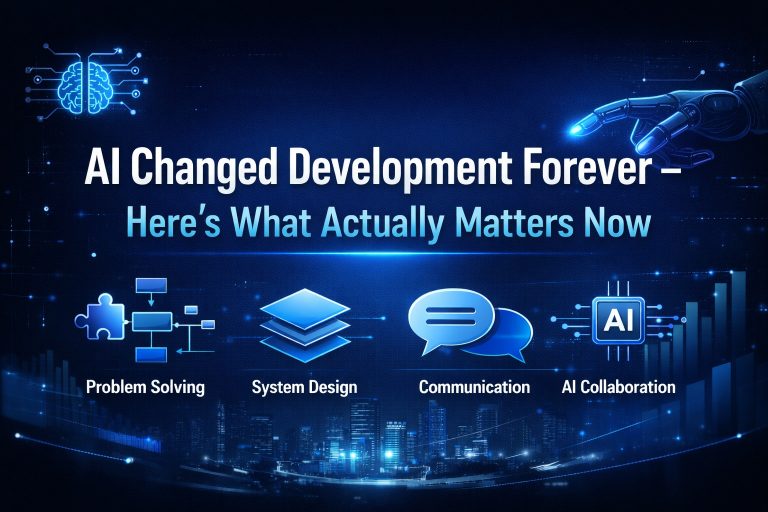
The New Developer Stack (2026)
Forget just “tech stack”.
This is your real stack now:
- 🧠 Problem solving
- 🏗 System design
- 💬 Communication
- 🤖 AI collaboration
- 🔁 Adaptability
These are multipliers.
They turn:
- junior → impactful
- mid → senior
- senior → architect
Final Reality Check
Ask yourself:
- Can I break down complex problems?
- Can I design systems, not just features?
- Can I explain decisions clearly?
- Do I use AI intentionally?
- Am I learning continuously?
If not — that’s your roadmap.
Coding is no longer your edge.
Thinking is.
Communication is.
Adaptability is.
AI didn’t kill development.
👉 It raised the bar.
One Line to Remember
“In 2026, the best developers won’t be the best coders —
they’ll be the best thinkers.”