

For years, frontend development meant one thing:
👉 “There’s a library for that.”
Need HTTP requests? Axios.
Lazy loading? Another package.
Animations? Yet another dependency.
But here’s the reality in 2026:
Modern browsers already ship powerful, optimized APIs that eliminate entire categories of libraries.
If you’re still reaching for npm first—you’re probably over-engineering.
Let’s fix that.
1) File System Access API
Yes — real file system access, directly from the browser.
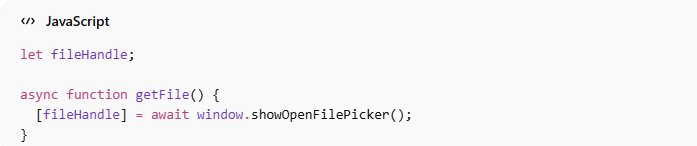
This API lets your app read and write files on the user’s device with proper permissions.
No hacks. No fake uploads. No backend needed.
Where it shines:
- Web-based editors (like VS Code in browser)
- Import/export workflows
- CSV / Excel tools
- Power-user apps
Why it’s a game-changer:
- Feels like a desktop app
- Removes need for file-processing libraries
- Enables real offline workflows
😄 First time using it feels slightly illegal.
⚠️ Support:
Best in Chromium browsers. Use as progressive enhancement.
👉 Verdict: This is how web apps become native-level tools.
2) BroadcastChannel API
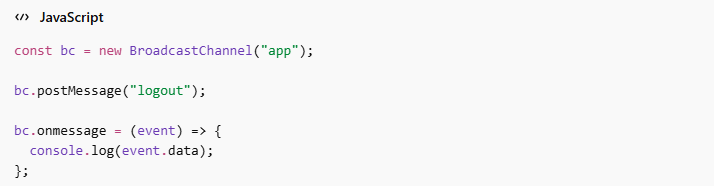
Tabs talking to each other — finally done right.
No more:
- localStorage hacks
- polling
- weird event syncing
Real use cases:
- Sync logout across tabs
- Share auth/session state
- Update UI everywhere instantly
- Multi-tab dashboards
Why it matters:
Users always open multiple tabs. This API makes that behavior predictable.
👉 Verdict: Clean, native state sync across tabs.
3) AbortController
Cancel anything. Cleanly. Like a pro.
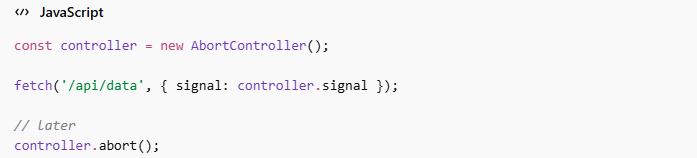
Most people think this is just for fetch.
It’s not.
It actually controls:
- Network requests
- Event listeners
- Streams
- Async workflows
Why it’s powerful:
- One signal → cancel multiple operations
- Prevent memory leaks
- Cleaner async logic
Real-world example:
User switches page → cancel everything instantly.
👉 Verdict: This is “senior-level” async control.
4) Structured Clone API
Deep copy — finally solved properly.
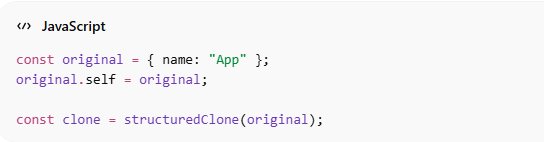
No more:
JSON.parse(JSON.stringify(...))- broken dates, maps, or circular refs
What it supports:
- Map, Set, Date, Blob, File
- Circular references
- Typed arrays
What it doesn’t:
- Functions (which is usually correct)
Why it matters:
- Predictable cloning
- Zero edge-case bugs
- No helper libraries
👉 Verdict: The end of “how to deep copy?” debates.
5) Performance API
Stop guessing. Start measuring.
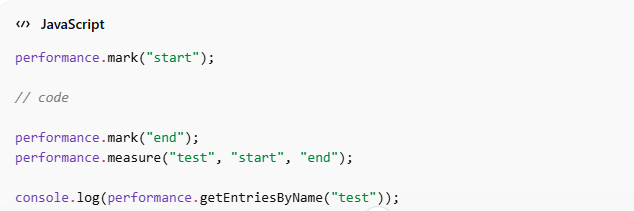
We all talk about optimization.
Few actually measure.
What this gives you:
- Real execution timing
- Micro-benchmarks
- Evidence-based decisions
Perfect for:
- Comparing implementations
- Testing Web Workers impact
- Validating architecture decisions
Reality check:
Sometimes your “optimized” version is slower 😅
👉 Verdict: Data > assumptions.
These APIs let you:
- Reduce dependencies
- Ship smaller bundles
- Build faster apps
- Think more like a systems engineer
🔥 TL;DR
| Problem | Library | Native API |
|---|---|---|
| File handling | FileSaver / custom logic | File System Access |
| Multi-tab sync | localStorage hacks | BroadcastChannel |
| Cancel async ops | custom logic | AbortController |
| Deep cloning | lodash.cloneDeep | structuredClone |
| Performance testing | external tools | Performance API |
Tired of overengineered solutions, slow performance, and endless dependencies?
At Skynix, we build fast, scalable, and modern web applications using the right approach from day one — native-first, performance-driven, and business-focused.
📩 Ready to upgrade your product?
👉 Let’s talk: https://skynix.co
👉 Or message us directly — we’ll review your project and suggest the best solution