
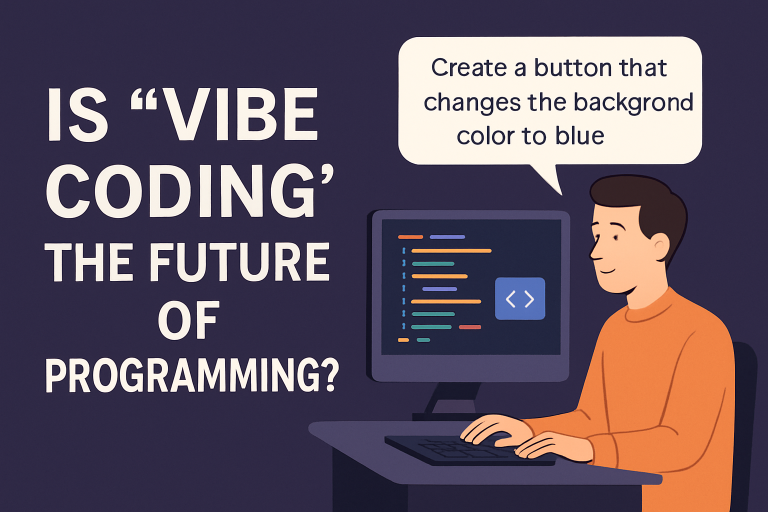

The future of programming might not be written in syntax—it could be spoken in plain English.
A new paradigm is quietly transforming how we build software, and it’s called vibe coding. Thanks to rapid advances in AI, especially large language models like GPT-4, we’re now able to write code not by typing lines of JavaScript, Python, or C#, but by describing what we want the code to do.
Sound futuristic? It’s already happening.
🚀 What Is Vibe Coding?
Vibe coding is the practice of generating code by simply expressing your intent in natural language. For example, you might say:
“Create a button that, when clicked, changes the background color of the webpage to blue.”
An AI like ChatGPT interprets your request and generates the corresponding code—ready to copy, test, or refine.
This approach allows developers (and even non-developers) to focus more on the outcome than the technical implementation. Syntax rules, boilerplate code, and remembering obscure function names? That’s the AI’s job now.
✅ The Pros of Vibe Coding
- Accessibility for All. You don’t have to be a seasoned developer to create something functional. If you can describe it, you can (almost) build it.
- Speed & Efficiency. Skip the setup. Skip the stack overflow rabbit holes. Vibe coding accelerates the development process dramatically.
- Creative Freedom. Developers can spend more time on big-picture thinking—architecture, experience, innovation—instead of obsessing over semicolons and brackets.
- Lower the Learning Curve. Beginners can participate sooner, and experts can prototype faster.
⚠️ The Cons—and Why You Still Need to Know Code
Before you quit your coding bootcamp, let’s get real.
↪️ Messy Code Output. AI-generated code can be bloated, inefficient, or hard to debug. It’s not always optimized.
↪️ Security Risks. Code from external AI sources may introduce vulnerabilities. Never blindly trust generated code—always review and test.
↪️ Loss of Skill Over Time. Relying on AI too much might weaken a developer’s core abilities, especially for beginners who skip foundational learning.
↪️ Harder Maintenance. Code that’s not well-structured or deeply understood can become a maintenance nightmare.
📌 Best Practices for Using Vibe Coding
If you’re tempted to give vibe coding a try (and you should!), here are a few essential tips to stay in control:
- Review the Code
Don’t just copy and paste. Make sure you understand how the code works. - Prompt in Small Chunks
Generate small pieces of functionality one at a time. It’s easier to manage, test, and debug. - Test Thoroughly
Run your code. Monitor for exceptions. Don’t skip QA just because a robot wrote it. - Stay Involved
Use AI as a tool, not a crutch. Keep learning the fundamentals. AI helps you code faster, not code less.
💡 So… Is This the Future?
Vibe coding is undeniably powerful—and it’s only the beginning. As language models improve, the quality of generated code will improve too. But for now, it’s best seen as a tool that augments, not replaces, human developers.
Use it wisely, stay curious, and keep your coding muscles strong.
Whether you’re a seasoned dev or someone just starting out, vibe coding offers a glimpse into a future where ideas become software faster than ever. Just remember: the best programmers won’t be the ones who type the fastest—they’ll be the ones who think the clearest.
🎥️ Subscribe to our YouTube channel so you never miss a new video